The Modern Landscape of Fine Jewelry
When investing in everyday luxury jewelry, contemporary buyers prioritize visual brilliance, ethical sourcing, mineral durability, and long-term value. Today, advanced laboratory crystallization allows master gemologists to craft colorless stones that rival traditional mined gems in optical fire while maintaining structural consistency.
Among modern lab-created stones, moissanite and 5A cubic zirconia represent the two most widely referenced choices. While both provide a clean, colorless appearance on the surface, they belong to fundamentally distinct mineral categories. Their atomic bonding dictates their surface hardness, light-bending refractions, and how their facets hold up through years of daily wear.
This comprehensive guide breaks down the physical properties, optical metrics, setting techniques, and care routines of both stones to help you build an enduring jewelry rotation.
1. Mineral Origins: Silicon Carbide vs. Zirconium Dioxide
A gemstone’s resilience originates in its atomic lattice:
- Moissanite (Silicon Carbide – SiC): First identified in 1893 by French Nobel laureate Henri Moissan within meteorite fragments, natural silicon carbide is exceedingly rare on Earth. Modern fine jewelry utilizes lab-synthesized moissanite grown under high-temperature thermal conditions over several months. Its covalent molecular structure is compact, resulting in a crystalline matrix comparable to the tight atomic bonds of diamond.
- 5A Cubic Zirconia (Zirconium Dioxide – ZrO2): Cubic zirconia is synthesized by melting zirconium dioxide powder with stabilizers at extreme temperatures exceeding 4,500°F (2,500°C). The “5A” designation denotes the premier industrial grading tier, signifying that the crystal was cut with precision to ensure optimal facet alignment, polish smoothness, and complete optical transparency.
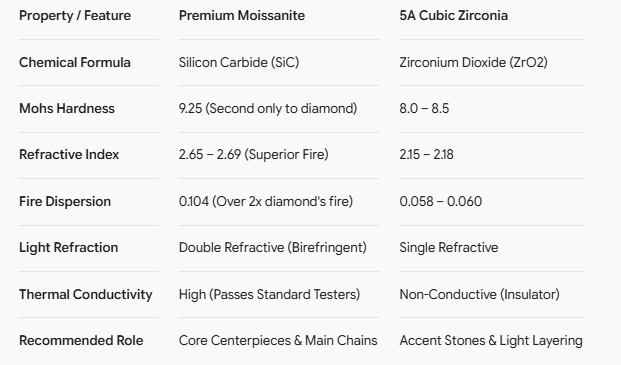
2.Physical & Optical Specifications
(放莫桑钻图片 设置链接跳转产品页面/最好设立莫桑钻专区))
(图片下方写产品名称)
3. Mohs Hardness and Scratch Resistance in Daily Life
The durability of everyday jewelry depends largely on its ability to withstand surface scratches caused by ambient airborne dust. Standard household dust contains microscopic quartz granules, which register at 7.0 on the Mohs scale. Any gemstone softer than quartz will accumulate microscopic scuffs over time, leading to dulled facets and a hazy appearance:
- Moissanite: 9.25 on the Mohs Scale. Ranking second only to natural diamond (10), moissanite easily resists abrasion from quartz, keys, door handles, and textured fabrics. Its facets remain sharp, ensuring the stone never clouds or loses its mirror reflection. It is built to serve as an enduring centerpiece that can be worn without anxiety during daily commutes, office work, and social engagements.
- 5A Cubic Zirconia: 8.0–8.5 on the Mohs Scale. While significantly harder than ordinary crystal or glass jewelry (5.0–6.0), 5A CZ is softer than moissanite. Over prolonged periods of frequent wear, its facet junctions can experience mild softening. For this reason, 5A CZ performs best when set into protective prong or bezel mounts, utilized as delicate accent stones, or worn as seasonal fashion statement pieces.
4. Optical Dispersion: Fire, Brilliance, and Double Refraction
The distinctive visual identity of each stone comes down to how light is bent, split, and returned to the viewer’s eye:
- The Moissanite Rainbow Fire: Moissanite features an unmatched Refractive Index of 2.65–2.69 and a dispersion rating of 0.104—more than double that of mined diamonds. In addition, moissanite is doubly refractive (birefringent). When light penetrates the stone, it splits into two distinct rays, creating explosive, rainbow-colored flashes across all lighting conditions. Even under overcast skies or warm interior lighting, our certified moissanite collection delivers breathtaking spectral brilliance.
(加粗certified moissanite collection 设置跳转莫桑钻产品款式分类页) The 5A Cubic Zirconia Crisp Sparkle: With a Refractive Index of 2.15–2.18 and single refraction, 5A cubic zirconia delivers a clean, diamond-like icy-white sparkle. It produces a crisp gleam suited for those who favor classic monochrome brilliance over intense multi-colored flashes. (放锆石产品图片 设置链接跳转产品页面) (图片下方写产品名称)
5. Understanding the 4Cs in Premium Moissanite
Just like fine diamonds, top-tier moissanite is evaluated against standard 4C benchmarks: Cut, Color, Clarity, and Carat:
- Cut (Precision Faceting): Cut determines over 70% of a stone’s visual performance. Our signature moissanites utilize the Hearts & Arrows (H&A) master cut—featuring mathematically calculated facets that optimize light return and eliminate dead spots.
- Color (D-Grade Purity): Modern synthesis eliminates the faint green or yellow undertones seen in older generations of lab stones. We select stones graded D Color (the highest achievable colorless grade), ensuring an icy, pure-white appearance mounted in silver.
- Clarity (VVS1 Flawless Standard): Our stones are rated VVS1 (Very, Very Slightly Included). At this clarity tier, internal inclusions are invisible to the naked eye and can only be detected under 10x gemological magnification.
Carat Equivalent Weight (DEW): Because moissanite is approximately 10–15% lighter in specific gravity than diamond, stones are measured using Diamond Equivalent Weight (DEW) based on millimeter measurements (e.g., a 6.5mm round stone corresponds to a 1.0ct diamond visual standard).
6. Thermal Conductivity & Gemstone Tester Verification
One of the most notable technical distinctions of moissanite is its thermal property. Standard handheld jewelry testing pens function by assessing how rapidly a crystalline material transfers heat away from the probe tip:
Because silicon carbide possesses high thermal conductivity nearly identical to that of diamond, authentic moissanite reliably triggers positive readings on standard thermal diamond testers.
Conversely, cubic zirconia is a thermal insulator; it restricts thermal transfer and registers a negative reading on thermal testers. For discerning jewelry enthusiasts, moissanite’s ability to pass standard thermal testing provides verified reassurance regarding its mineral density and physical authenticity.
7. Setting Integrity and Skin-Safe Foundation Metals
A gemstone of permanent hardness requires a protective, high-integrity mount. All pieces across our catalog are crafted from solid 925 sterling silver, hand-set using traditional metal claws rather than surface adhesives:
- Open Under-Galleries: Settings are constructed with open basket architecture to permit natural light to flood the pavilion facets of the stone, maximizing upward light refraction.
- Protective Electroplating: Our silver foundations undergo multi-layered electroplating with precious rhodium and 14K white gold. This forms a scratch-resistant barrier that shields the underlying silver from moisture and atmospheric sulfur.
- Hypoallergenic Verification: All settings are strictly nickel-free and lead-compliant, preventing skin discoloration and irritation for sensitive skin. To confirm your correct sizing before purchasing, explore our official sizing and measurement guide.
(加粗official sizing and measurement guide 跳转尺码尺寸页面图)
8. Frequently Asked Questions (FAQ)
Q: Will moissanite cloud, yellow, or lose its fire over years of wear?
A: No. Moissanite is an inert, stable silicon-carbide crystal that does not absorb moisture, oils, or ambient chemicals. Any apparent loss of sparkle over time is simply the result of soap residue or hand lotion forming an external film over the facets. A brief wash with mild soap and a soft toothbrush immediately restores full optical fire.
Q: Can I wear my moissanite jewelry in water and during workouts?
A: While the moissanite gemstone itself is impervious to water and sweat, we recommend removing jewelry prior to entering chlorinated pools, salt water, or lifting heavy weights. Chlorine can gradually degrade metal electroplating, while heavy metal gym equipment can bend silver ring shanks.
Q: What is the primary role of 5A cubic zirconia in your catalog?
A: We reserve genuine moissanite as the primary centerpiece for core statement rings, solitaire pendants, and signature tennis chains. 5A cubic zirconia is selected for micro-pavé accents, halo frames, and accessible fashion pieces where delicate scale and clean white shine are desired.
Q: How does moissanite compare to laboratory-grown diamonds?
A: While both are lab-cultivated under rigorous controls, moissanite features a higher refractive index (2.65 vs. 2.42) and more than double the fire dispersion (0.104 vs. 0.044) of diamonds, delivering greater rainbow fire at an accessible value that supports daily wear without financial worry.
9. The Verdict: Why Moissanite Leads Our Signature Line
When seeking an everyday luxury piece that combines geological toughness, certified craftsmanship, and breathtaking visual dispersion, genuine moissanite remains the definitive focal choice for modern fine jewelry.
With its formidable 9.25 Mohs hardness rating, positive thermal tester verification, and brilliant D-color clarity, moissanite offers fine-jewelry luxury engineered for real life. If you are looking for an enduring signature design set in solid 925 sterling silver, our handcrafted moissanite jewelry collection brings together master faceting with skin-safe, protective craftsmanship.
(加粗 handcrafted moissanite jewelry collection 设置跳转莫桑钻产品分类页) EXPLORE OUR SIGNATURE MOISSANITE COLLECTION 加粗 再次设置跳转莫桑石专区链接主页